
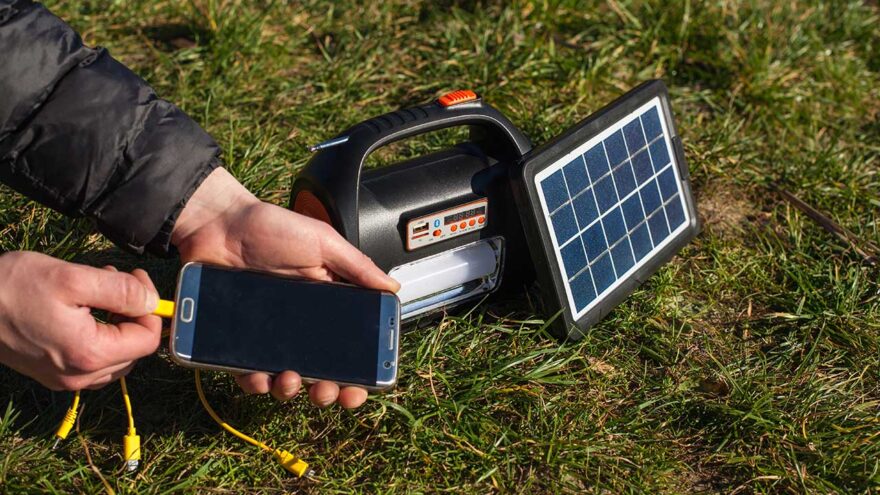
Portable power banks have become everyday items. Phones, earbuds, watches, and tablets all rely on them at some point. Solar power banks add another layer to that idea by including panels that can harvest energy from sunlight when wall outlets aren’t available.
A large-capacity solar power bank—often advertised with very high milliamp-hour ratings and extra features like flashlights and rugged housings—can be genuinely useful. But it’s also one of the most misunderstood categories of portable power.
This article explains what these power banks do well, what they don’t do, and how to decide whether one fits your actual needs.
What a Solar Power Bank Really Is
A solar power bank is still, first and foremost, a battery.
The solar panel:
- Supplements charging
- Extends usability off-grid
- Provides emergency flexibility
It does not turn the device into a full solar generator.
Most solar power banks combine:
- A high-capacity lithium battery
- One or more small solar panels
- Multiple USB output ports
- A rugged or water-resistant shell
- Auxiliary features like LED flashlights
Understanding the solar component as a bonus, not a primary charging method, sets the right expectations.
Understanding Capacity Numbers Without Marketing Confusion
Large numbers like “42800 mAh” can be misleading if taken at face value.
Battery capacity is often measured at the internal cell voltage (around 3.7V), while USB charging occurs at higher voltages (usually 5V or more). Energy is lost during voltage conversion.
In practical terms:
- Usable output is lower than the headline number
- Efficiency varies by device and cable
- Simultaneous charging reduces total runtime
This isn’t deception—it’s how all battery packs are measured—but it’s important to know what the numbers actually represent.
What Solar Charging Is Good For
The integrated solar panel is best used as:
- A maintenance charge
- A slow top-up
- An emergency extension
In ideal sunlight, small panels can:
- Add incremental charge over hours
- Slow battery drain
- Keep essential devices alive longer
They are not designed to:
- Fully recharge a large battery quickly
- Replace wall charging
- Function reliably in poor weather
For most users, solar charging is a backup, not the main event.
Where These Power Banks Shine in Real Life
Emergency Preparedness
During power outages or unexpected disruptions, a solar power bank can:
- Keep phones charged for communication
- Power small USB lights
- Provide a flashlight from the built-in LED
This makes them popular additions to emergency kits.
Outdoor Activities
Campers, hikers, and travelers benefit from:
- Large capacity
- Rugged construction
- Multiple device charging
- Optional solar assistance
When outlets are unavailable, flexibility matters more than speed.
Long Days Away From Power
Festivals, road trips, and extended outings often push phone batteries hard. A large power bank reduces anxiety around running out of power mid-day.
Multiple Ports and Charging Multiple Devices
Most large solar power banks include:
- Multiple USB-A ports
- Sometimes USB-C output
- Occasional wireless charging
This allows:
- Charging several devices at once
- Sharing power between people
- Supporting mixed device types
The trade-off is that charging multiple devices divides output and reduces overall runtime.
Built-In Flashlights: More Useful Than They Sound
The LED flashlight is often overlooked, but in practice it:
- Adds utility during outages
- Helps with nighttime outdoor tasks
- Removes the need for a separate light source
It draws from the same battery, so using it sparingly helps preserve charge for devices.
Weight and Portability Trade-Offs
High capacity comes with bulk.
Large solar power banks:
- Weigh more than pocket chargers
- Take up more space
- Are better carried in bags than pockets
They’re not ideal for minimalist daily carry, but they excel as:
- Travel companions
- Emergency tools
- Base-camp power sources
Charging the Power Bank Itself
Wall charging remains the most efficient way to recharge these devices.
Best practice:
- Fully charge via wall outlet before trips
- Use solar panels only as supplemental charging
- Avoid leaving the bank exposed to excessive heat
Solar panels are sensitive to angle, temperature, and sunlight quality. Even small adjustments can affect performance.
Durability and Water Resistance
Many models advertise water resistance or rugged design.
In practice:
- Splash resistance is common
- Submersion is not recommended
- Ports should remain sealed when not in use
Treat them as outdoor-capable electronics, not waterproof tools.
Common Misconceptions
“Solar means unlimited power.”
Solar panels on power banks are small and slow. They extend use; they don’t eliminate limits.
“Higher mAh always means more usable charges.”
Efficiency losses and device differences matter.
“They replace generators.”
They complement emergency planning, but they are not replacements for large power systems.
Who Benefits Most From This Category
Solar power banks are best suited for:
- Emergency preparedness planners
- Campers and outdoor enthusiasts
- Travelers spending time off-grid
- People who want redundancy, not speed
They’re less ideal for:
- Daily pocket carry
- Fast charging needs
- Replacing wall outlets entirely
Practical Tips for Best Results
- Charge fully from a wall outlet before use
- Use solar panels only as a supplement
- Keep ports dry and sealed
- Use quality cables
- Avoid prolonged heat exposure
Small habits extend lifespan and reliability.
Longevity and Battery Health
Like all lithium batteries:
- Capacity slowly decreases over time
- Extreme heat accelerates wear
- Deep discharges should be avoided when possible
Using the bank periodically and storing it partially charged helps maintain battery health.
Final Perspective
A large solar power bank is best understood as a flexibility tool, not a miracle charger.
Its real value lies in:
- Redundancy
- Preparedness
- Peace of mind
When expectations are realistic, these devices are incredibly useful companions for travel, emergencies, and long days away from power. When expectations are inflated, disappointment follows.
Used as designed—with solar as support rather than reliance—a high-capacity solar power bank earns its place in a kit where reliability matters more than speed.